






Sanity build
Slingshot Bio
Roboto converged Slingshot Bio's WordPress and Shopify sites into one headless Shopify build on Next.js and Sanity, instrumented end to end and AI-ready.
View case study

Starred Sanity partner, authors of Turbo Start Sanity. We build, migrate and tune the studios behind Helix, Tabby and Global Cycling Network.

Discovery Channel
(opens in new tab)
Ministry of Defence
(opens in new tab)
Bush Centre
(opens in new tab)
Tray
(opens in new tab)
Warner Bros
(opens in new tab)
Chelsea Piers
(opens in new tab)
Scape Group
(opens in new tab)
Mario Testino
(opens in new tab)
Jamb
(opens in new tab)
Helix
(opens in new tab)
Tabby
(opens in new tab)
Topaz Labs
(opens in new tab)Each arrived with its own procurement, security review and legacy stack. Our delivery process is shaped by the ISO 27001 work we have underway.
My best experience with a consulting company. The results were delivered faster than expected and with top quality. Jono ensured I understood the process and suggested a great approach. Both execution and communication were flawless.

CEO at Topaz Labs
Semantic search on Sanity's embeddings index. Keyword gaps pulled from Ahrefs. Whatever your content team needs, wired into the studio.
Composable and API-first
Sanity is a database with an editor on top, not a website tool. Your site, your app and whatever you launch next read the same content through one API.
Content operations and releases
Scheduled releases, granular roles and real-time collaboration in one place. Your team runs a launch without a spreadsheet tracking who changed what.
Media library and headless DAM
Sanity Media Library gives an organization one asset store across every studio, with custom metadata and collections. We add automated OG images and per-channel crops on top.
Headless commerce on Shopify
Sanity Connect mirrors your Shopify catalog into the Content Lake so editorial wraps around live product data. turbo-start-shopify is the starter we ship it on.
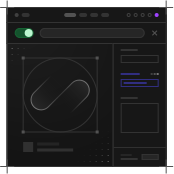
Visual editing and live preview
Presentation gives editors click-to-edit overlays on the real page, next to the studio. They preview a campaign, hit publish and watch the live site change without a redeploy.
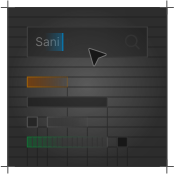
Custom plugins and studio tooling
When the defaults run out of road we extend the studio. Custom input components, internal dashboards and workflow widgets Sanity doesn't ship, all yours to keep.
The Mario Testino archive came to us at 200% API overage with 160+ redirects missing. Each page below covers the schema, the 301 plan and the cutover.
Right-to-left styling lives in the component library, not patched on afterwards. One content model, one editorial workflow, every locale.
It tracks your codebase instead of a stale snapshot, so marketing stops queuing behind an engineer for answers.
Page building (opens in new tab) and SEO optimization (opens in new tab). We're the only agency ever to write official Sanity Learn courses. Turbo Start Sanity (opens in new tab) is ours too, the starter every new studio here begins from.
Sanity is a headless, API-first content platform. Editors work in Sanity Studio (a customizable React-based editor that runs in the browser), and content is stored in Content Lake and delivered through GROQ, GraphQL or the Live Content API to whatever frontend you're building. The Studio is fully open source, so the parts that don't quite fit your team can be extended or replaced. That's where most of our work happens.
Roboto Studio is a starred Sanity partner with a San Francisco office at 2021 Fillmore St, CA 94115: one of 15 starred agencies in Sanity's 218-agency directory. US Sanity clients include Topaz Labs, Slingshot Bio and Helix. Projects start at $25k+. When you shortlist, check starred-partner status, named US clients and a published minimum. We published how we rank Sanity agencies, including the ones we'd recommend over us.
The Free plan covers 20 seats, 10,000 documents and 1M CDN API requests a month at $0. Growth is $15 per seat per month for up to 50 seats and 25,000 documents, with the same API allowances plus pay-as-you-go overages beyond them. Enterprise is custom pricing for teams that need SSO, custom roles or a dedicated SLA.
The honest answer most agencies skip: budget for the implementation and content-modeling work too. The license is usually a small fraction of total cost in year one, and a well-modeled studio earns that fee back inside the first few campaigns. Our Sanity pricing breakdown compares the plans in more detail.
Yes, and the free plan stays free with no time limit. It covers 20 user seats, 10,000 documents, 1M CDN API requests a month, 250K regular API requests and 100GB of assets.
You outgrow it when you need more than 20 seats, more than 10,000 documents, scheduled publishing, private datasets, or roles beyond admin and viewer. The next step up is Growth at $15 per seat per month.
$15 per seat per month on the Growth plan, charged for editor seats only, with viewer seats free. Growth runs up to 50 seats, so a team of 10 editors pays $150 a month before any overages.
Under 20 seats the Free plan costs nothing. Past 50 seats, or if you need SSO or custom roles, you move to Enterprise and Sanity quotes you directly.
For a site of 500 to 2,000 pages, 4 to 8 weeks end to end. Mapping your existing content model to a Sanity schema is 1 to 2 weeks of that.
Editor training is a 2 hour onboarding session and most teams publish confidently inside a week. Livemore's marketing team shipped 12 campaign pages in their first month on the studio we built.
If your team is mostly publishing blog posts on a single website and you're happy with WYSIWYG editing, WordPress is fine. If you're publishing structured content into multiple channels (a website, a mobile app, an in-store screen), or your editors keep hitting WordPress's limits with custom fields and ACF workarounds, Sanity is the right move.
We run WordPress-to-Sanity migrations regularly: we map every legacy URL, preserve SEO equity with 301s, redesign the content model around how editors actually work, and train the team before cutover so they're ready to publish on launch day. Our WordPress-to-Sanity migration guide walks through the process.
Strapi is self-hosted and open source; Sanity is hosted with a much more polished editor and a real-time Content Lake. Strapi makes sense if data residency or self-hosting is non-negotiable and you have the DevOps budget to run it. Sanity makes sense for almost everyone else. The editor, the live preview, the Presentation tool and scheduled publishing are years ahead, and you don't pay for the infrastructure to keep them running. We've migrated teams in both directions and Sanity wins on editorial velocity in most scenarios.
Sanity Studio (the editor) is open source and runs anywhere you deploy a Next.js or Vite app: Vercel, your own infrastructure, behind a VPN. The Content Lake (the database) is Sanity-hosted and not available as a self-hosted product. For teams with strict data residency requirements, Sanity offers regional hosting and Enterprise data-handling agreements; we'll walk you through the options on a scoping call.
Next.js, almost always. The App Router, server components and streaming model fit Sanity's GROQ-on-the-server pattern perfectly, and Vercel's caching primitives make revalidateTag invalidations from Sanity webhooks trivial. We cover the performance and metadata details in our Sanity and Next.js SEO tips.
For brochure sites with no interactive logic we'll sometimes recommend Astro instead, but nine out of ten production builds end up on Next.js, which is why Turbo Start Sanity (opens in new tab) is a Next.js + Sanity starter.
Almost never. Every time we've inherited a "painful" Sanity studio, the schema turned out to be the problem: references modeled as strings, page builders without thumbnails, validation rules nobody ever wrote.
A good Sanity studio is built around how editors actually work, and most agencies skip that step. Our guide to choosing a Sanity agency explains what to ask before hiring one. If you've got a Sanity build that's making editors miserable, we'll happily audit it and tell you honestly whether to fix it, rebuild the schema, or migrate to something else.

Looking for a Sanity CMS agency? Explore our complete guide covering pros, cons, and red flags. (Fair warning: we're an agency, but only slightly biased!)


Guess what? We're Sanity agency partners. Learn how coupling a top-tier CMS with a high-performance frontend delivers an unparalleled web experience.

Choosing the right CMS price bracket? We decode Sanity's pricing to help you decide between lean & budget-friendly or splurging for extra features.
Tell us what you're building. We reply within one working day. Jono or someone on the team picks up every message personally.
Usage-driven estimate, rates checked 2026-08-11
Rough numbers, but useful ones. Start from the archetype closest to your site. Sanity’s quotas are the same for everyone on the plan; what sends the bill up is how many requests your front end makes to render the same page.
Across the whole site, as your analytics reports it.
Drafts and published versions both count towards the quota.
People who create or publish. Viewer seats are free and excluded.
Images, video and files held in Sanity.
Datasets beyond the two your plan includes. Usually none.
Quota usage
| Line | Share of quota used | Monthly |
|---|---|---|
| Editor seats4 | $60 | |
| Bandwidth14.9 GB of 100 GB | included | |
| API CDN requests45.1K of 1M | included | |
| Uncached API requests920 of 250K | included | |
| Asset storage8 GB of 100 GB | included | |
| Documents400 of 25K on Growth | included | |
| Extra datasets0 | included |
Modelled from Sanity's published quotas; measured presets come from real accounts, kept anonymous. Roboto doesn't resell Sanity seats.